Buy webmails.eu ?
We are moving the project
webmails.eu .
Are you interested in purchasing the domain
webmails.eu ?
domain@kv-gmbh.de · 0541-91531010
Buy webmails.eu ?
How do you transform an object clause or a subject clause into a dependent clause (subordinate clause)?
To transform an object clause or a subject clause into a dependent clause, you can add a subordinating conjunction at the beginning of the clause. For example, changing "I know that he is coming" (object clause) to "I know when he is coming" (dependent clause). Another way is to remove the subject or object pronoun and change the verb form to make it dependent on the main clause. For instance, changing "She believes she can win" (subject clause) to "She believes she can win" (dependent clause). **
Is an infinitive clause a subordinate clause?
Yes, an infinitive clause is a type of subordinate clause. It functions as a single unit within a sentence and is dependent on the main clause for its meaning. Infinitive clauses typically begin with the word "to" followed by a verb, and they can serve various purposes such as expressing purpose, result, or obligation. **


Similar search terms for Clause
Top-Angebote
Products related to Clause:
-
Dermagius Compose Hidracare Cream-Gel 24-Hour Moisturizing 30mLA facial cream. Transform your skincare with Compose Hidracare Cream-Gel – a 24-hour lightweight moisturizer that hydrates, balances, and revitalizes all skin types. Hydrate, Balance, Flourish. 24-hour hydration with a light, fast-absorbing gel-cream texture. Rebalances skin’s microflora for a healthier complexion.17,74 £*Shipping: 5,16 £Secure redirect to the provider
-
Blueprint Hello Kitty and Friends Sweets Backpack for Kids - Pastel Pink - A4 Folders/Smaller LaptopsBring a little kawaii character style to school days, outings, and everyday adventures with this colourful Hello Kitty and Friends Sweets Backpack. The pastel pink design features an all-over pattern of Hello Kitty, Kuromi, My Melody, and Cinnamoroll surrounded by playful sweets and colourful treats. A spacious zipped main compartment provides room for books, stationery, snacks, and other daily essentials. It is generously sized for A4 folders and may also accommodate some smaller laptops. The separate front zipped pocket keeps smaller belongings within easy reach and is decorated with raised character artwork for an extra-special finish. Designed with comfort and practicality in mind, the backpack has adjustable padded shoulder straps that can be fitted to the wearer. A top grab handle makes it easy to carry by hand or hang from a school peg. Its hard-wearing polyester fabric is splash-resistant, helping to keep the contents protected.16,25 £*Shipping: 3,95 £Secure redirect to the provider
-
Smart Shopping Spot Letter & Legal File Storage Box With Organizer Lid Durable Plastic File Storage Box For Hanging Folders Letter & Legal File Storage Box With Organizer Lid Durable Plastic File Storage Box For Hanging FoldersClear the chaos from your desk and reclaim your focus with a premium plastic file storage box that brings calm to paperwork. Designed for professionals, students, and busy households, this legal and letter file box keeps important documents neat,...119,97 $*Shipping: 0,00 $Secure redirect to the provider


-
What are main clause-subordinate clause constructions?
Main clause-subordinate clause constructions are sentences that consist of a main clause and one or more subordinate clauses. The main clause is a complete sentence that can stand alone, while the subordinate clause depends on the main clause for its meaning and cannot stand alone. Subordinate clauses often begin with subordinating conjunctions such as "because," "although," "if," or "when," and they provide additional information or context to the main clause. These constructions allow for more complex and nuanced sentence structures, and they are commonly used in both spoken and written language. **
-
Can an adverbial clause also be a subject clause or an object clause?
No, an adverbial clause cannot be a subject clause or an object clause. An adverbial clause functions as an adverb to modify a verb, adjective, or adverb in a sentence. Subject clauses and object clauses, on the other hand, serve as the subject or object of the main clause, respectively. Each type of clause has a specific grammatical function within a sentence. **
-
Is the main clause and subordinate clause correct?
To determine if the main clause and subordinate clause are correct, you need to ensure that they are grammatically sound and that they make sense when combined. The main clause should be able to stand alone as a complete sentence, while the subordinate clause provides additional information but cannot stand alone. Checking for subject-verb agreement and proper punctuation between the two clauses can help confirm their correctness. **
-
How do I recognize a relative clause, a conjunctional clause, and an interrogative clause?
A relative clause typically starts with a relative pronoun (such as who, whom, whose, which, or that) and provides more information about a noun in the main clause. A conjunctional clause, on the other hand, is introduced by a conjunction (such as and, but, or because) and connects two independent clauses. An interrogative clause is a type of clause that asks a question and is typically introduced by an interrogative pronoun (such as who, what, when, where, why, or how) or an interrogative adverb (such as how, when, or where). **

How can I recognize a relative clause, a conjunctional clause, and an interrogative clause?
A relative clause is a type of dependent clause that typically starts with a relative pronoun (such as who, whom, whose, which, or that) and provides additional information about a noun in the main clause. A conjunctional clause, on the other hand, is a dependent clause that functions as an adverb, adjective, or noun in a sentence and is connected to the main clause by a conjunction (such as because, although, if, when, etc.). An interrogative clause is a type of clause that asks a question and typically begins with a question word (such as who, what, where, when, why, or how) or with a helping verb followed by the subject. **
Is the accompanying clause in direct speech a main clause or a subordinate clause?
The accompanying clause in direct speech can be either a main clause or a subordinate clause, depending on its role in the sentence. If the clause is expressing a complete thought and can stand alone as a sentence, then it is a main clause. However, if the clause is dependent on the rest of the sentence for its meaning and cannot stand alone, then it is a subordinate clause. It's important to consider the context and structure of the sentence to determine the role of the accompanying clause in direct speech. **
Top-Angebote
Products related to Clause:
-
Modway Compose Performance Velvet Accent ChairExperience unparalleled elegance and comfort with the Compose Performance Velvet Armchair. This stunning barrel chair, upholstered in stain-resistant performance velvet fabric, is the epitome of modern luxury.481,49 $*Shipping: 0,00 $Secure redirect to the provider
-
Dermagius Compose Mousse Facial Soap Gentle CleaningA cleansing product for sensitive skin. Gently removes impurities while preserving skin hydration. Reduces excess oil and soothes sensitive skin. Combats premature aging with antioxidant-rich ingredients. Leaves skin clean, soft, and lightly fragranced. Suitable for all skin types, including dry and sensitive.23,71 £*Shipping: 9,68 £Secure redirect to the provider
-
Dermagius Compose Hidracare Cream-Gel 24-Hour Moisturizing 30mLA facial cream. Transform your skincare with Compose Hidracare Cream-Gel – a 24-hour lightweight moisturizer that hydrates, balances, and revitalizes all skin types. Hydrate, Balance, Flourish. 24-hour hydration with a light, fast-absorbing gel-cream texture. Rebalances skin’s microflora for a healthier complexion.17,74 £*Shipping: 5,16 £Secure redirect to the provider
-
How do you transform an object clause or a subject clause into a dependent clause (subordinate clause)?
To transform an object clause or a subject clause into a dependent clause, you can add a subordinating conjunction at the beginning of the clause. For example, changing "I know that he is coming" (object clause) to "I know when he is coming" (dependent clause). Another way is to remove the subject or object pronoun and change the verb form to make it dependent on the main clause. For instance, changing "She believes she can win" (subject clause) to "She believes she can win" (dependent clause). **
-
Is an infinitive clause a subordinate clause?
Yes, an infinitive clause is a type of subordinate clause. It functions as a single unit within a sentence and is dependent on the main clause for its meaning. Infinitive clauses typically begin with the word "to" followed by a verb, and they can serve various purposes such as expressing purpose, result, or obligation. **
-
What are main clause-subordinate clause constructions?
Main clause-subordinate clause constructions are sentences that consist of a main clause and one or more subordinate clauses. The main clause is a complete sentence that can stand alone, while the subordinate clause depends on the main clause for its meaning and cannot stand alone. Subordinate clauses often begin with subordinating conjunctions such as "because," "although," "if," or "when," and they provide additional information or context to the main clause. These constructions allow for more complex and nuanced sentence structures, and they are commonly used in both spoken and written language. **
-
Can an adverbial clause also be a subject clause or an object clause?
No, an adverbial clause cannot be a subject clause or an object clause. An adverbial clause functions as an adverb to modify a verb, adjective, or adverb in a sentence. Subject clauses and object clauses, on the other hand, serve as the subject or object of the main clause, respectively. Each type of clause has a specific grammatical function within a sentence. **
Similar search terms for Clause
-
Blueprint Hello Kitty and Friends Sweets Backpack for Kids - Pastel Pink - A4 Folders/Smaller LaptopsBring a little kawaii character style to school days, outings, and everyday adventures with this colourful Hello Kitty and Friends Sweets Backpack. The pastel pink design features an all-over pattern of Hello Kitty, Kuromi, My Melody, and Cinnamoroll surrounded by playful sweets and colourful treats. A spacious zipped main compartment provides room for books, stationery, snacks, and other daily essentials. It is generously sized for A4 folders and may also accommodate some smaller laptops. The separate front zipped pocket keeps smaller belongings within easy reach and is decorated with raised character artwork for an extra-special finish. Designed with comfort and practicality in mind, the backpack has adjustable padded shoulder straps that can be fitted to the wearer. A top grab handle makes it easy to carry by hand or hang from a school peg. Its hard-wearing polyester fabric is splash-resistant, helping to keep the contents protected.16,25 £*Shipping: 3,95 £Secure redirect to the provider
-
Smart Shopping Spot Letter & Legal File Storage Box With Organizer Lid Durable Plastic File Storage Box For Hanging Folders Letter & Legal File Storage Box With Organizer Lid Durable Plastic File Storage Box For Hanging FoldersClear the chaos from your desk and reclaim your focus with a premium plastic file storage box that brings calm to paperwork. Designed for professionals, students, and busy households, this legal and letter file box keeps important documents neat,...119,97 $*Shipping: 0,00 $Secure redirect to the provider
-
ZADO - Leather Harness for Attachments (Brown)Experience full control and excitement with the premium quality leather strap-on harness, designed to provide the highest level of pleasure!Why is it great?Strong, stable snaps for secure attachment.Double metal rings for stable attachment of a suction cup dildo.The straps are adjustable, fitting most sizes.Made of quality leather with meticulous stitching and durable materials.Detachable rings for easy use.Keep in mind:Compatible with dildos up to 5 cm in diameter.Requires thorough cleaning and disinfection before and after use.Package does not include a dildo.How to use:Place the dildo in the ring facing upwards, then put on the harness and let the fun begin!Package contents:1 strap-on harness1 double metal carabiner (for connecting the dildo and platform)Product features:Strap-on harness for use with suction cup dildoZADO - premium quality leatherStable snaps for secure holdDouble metal ring for dildo attachmentAdjustable straps, fits most sizesDetachable rings for easy setupInner ring diameter: 3.8 cm and 5 cmFor dildos up to 5 cm in diameterColor: BrownMaterial: Buffalo leather, metal (chrome-free)Available sizes: S/M, L/XL, XXLCleaning recommendation:Wash thoroughly with mild soapy or detergent water, rinse, and let dry.User manual67,44 £*Shipping: 6,10 £Secure redirect to the provider
-
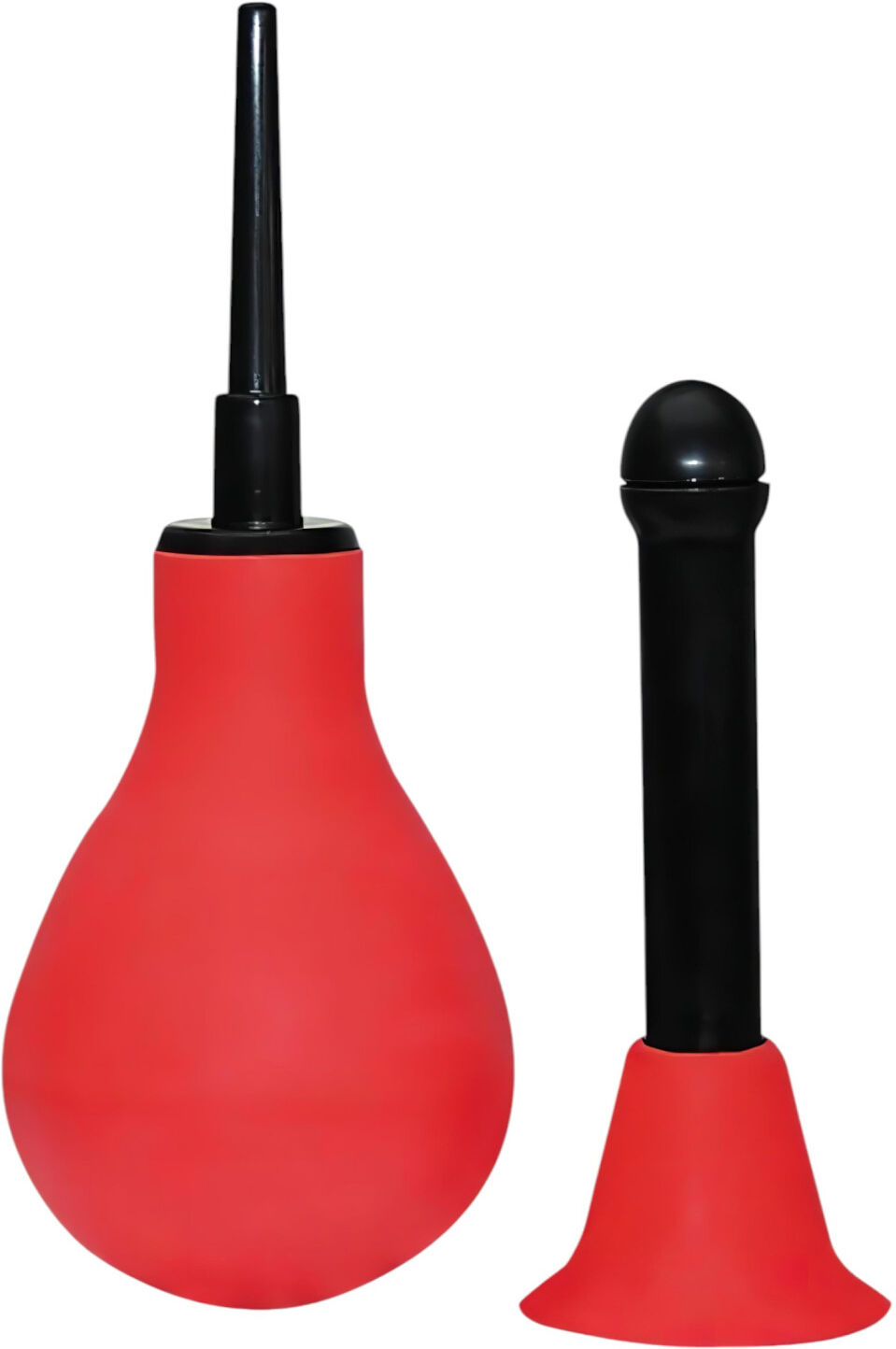
You2Toys - Intimate Cleaner with Two AttachmentsComplete Cleanliness, Maximum Comfort – Whether for Anal or Vaginal Use, This Set Caters to All Your Needs! Why It's Great: Can be used for both anal and vaginal cleaning Two different heads for comfortable use The bulb is easy to squeeze Simple to use Extra water-repellent rim on the nozzle for hygienic cleaning Important Tips: Clean thoroughly before and after each use Always fully attach the head to the bulb How to Use: The thinner head is for anal washing, the thicker is for vaginal rinsing. Always clean the product before use, then fill the bulb with lukewarm water under a tap. Slowly insert and inject water into the anus or vagina by squeezing the bulb. For anal washing, hold the liquid for a while, then release it, repeating until the discharged liquid is completely clear. Product Specifications: The bulb is approximately 10 cm high Capacity: 220 ml Anal nozzle size: 8 cm Vaginal nozzle size: 14 cm Available in red and black Material: ABS, PVC, and Latex Set Contents: Bulb Anal nozzle Vaginal nozzle Cleaning Advice: Wash thoroughly with mild soapy, lukewarm water, then rinse and let dry. Recommended: Use a special cleaner (06305000000) - available separately. User manual16,34 £*Shipping: 6,10 £Secure redirect to the provider
-
Is the main clause and subordinate clause correct?
To determine if the main clause and subordinate clause are correct, you need to ensure that they are grammatically sound and that they make sense when combined. The main clause should be able to stand alone as a complete sentence, while the subordinate clause provides additional information but cannot stand alone. Checking for subject-verb agreement and proper punctuation between the two clauses can help confirm their correctness. **
-
How do I recognize a relative clause, a conjunctional clause, and an interrogative clause?
A relative clause typically starts with a relative pronoun (such as who, whom, whose, which, or that) and provides more information about a noun in the main clause. A conjunctional clause, on the other hand, is introduced by a conjunction (such as and, but, or because) and connects two independent clauses. An interrogative clause is a type of clause that asks a question and is typically introduced by an interrogative pronoun (such as who, what, when, where, why, or how) or an interrogative adverb (such as how, when, or where). **
-
How can I recognize a relative clause, a conjunctional clause, and an interrogative clause?
A relative clause is a type of dependent clause that typically starts with a relative pronoun (such as who, whom, whose, which, or that) and provides additional information about a noun in the main clause. A conjunctional clause, on the other hand, is a dependent clause that functions as an adverb, adjective, or noun in a sentence and is connected to the main clause by a conjunction (such as because, although, if, when, etc.). An interrogative clause is a type of clause that asks a question and typically begins with a question word (such as who, what, where, when, why, or how) or with a helping verb followed by the subject. **
-
Is the accompanying clause in direct speech a main clause or a subordinate clause?
The accompanying clause in direct speech can be either a main clause or a subordinate clause, depending on its role in the sentence. If the clause is expressing a complete thought and can stand alone as a sentence, then it is a main clause. However, if the clause is dependent on the rest of the sentence for its meaning and cannot stand alone, then it is a subordinate clause. It's important to consider the context and structure of the sentence to determine the role of the accompanying clause in direct speech. **
* All prices are inclusive of VAT and, if applicable, plus shipping costs. The offer information is based on the details provided by the respective shop and is updated through automated processes. Real-time updates do not occur, so deviations can occur in individual cases. ** Note: Parts of this content were created by AI.